










Choosing The Best Laser Engraver for Aluminum: Buying Guide and Top Picks
To engrave or mark aluminum effectively, you need a 1064nm fiber laser (20W to 60W+) for bare metal, or a standard diode laser if you're only stripping the colored coating off anodized aluminum or using marking sprays. That is because which type of laser engraver will be best for aluminum varies depending on the kind of aluminum in question.
Standard blue-light diodes and CO2 lasers bounce off raw aluminum and can't carve into it, so choosing the best laser engraver for aluminum usually comes down entirely to two important factors: whether your aluminum is raw or anodized, and your budget.

2 Primary Laser Engraver Types for Aluminum
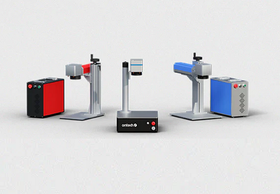
- Fiber lasers (1064nm): The gold standard for raw, bare aluminum. They engrave deep, fast, permanent marks. Popular entry-to-mid-tier hobbyist/prosumer options include the OMTech, ComMarker B4, and Gweike G2.
- Diode lasers (with tricks): Blue diode lasers can't engrave bare aluminum, but they can burn off the top layer of anodized aluminum to reveal the silver metal underneath. For bare aluminum, you'd need to use marking sprays like Cermark or LaserDark so the chemical bonds to the surface under the diode beam.
Choosing the Best Laser Engravers for Anodized Aluminum
If you intend to engrave only anodized aluminum (as opposed to raw aluminum), the technical requirements change drastically. You no longer need a dedicated fiber laser to carve away raw metal; a standard diode or CO2 laser engraver is all you need.
That's because engraving anodized aluminum doesn't involve cutting into the metal at all. It's simply a process of bleaching or vaporizing the organic color dye layer trapped inside the surface anodization, which reveals the naturally bright, off-white aluminum color underneath and creates a permanent, high-contrast mark.
Because the dye layer is microscopic, standard diode and CO2 lasers handle this perfectly, which means you can drop your entry budget significantly.
Recommended Laser Engravers for Anodized Aluminum Only
1. Best Affordable / Entry-Level (Under CA$2,500): Aufero AL2 Laser Engraver Machine
An open-frame, exceptionally cheap entry point. Equipped with a 5W or 10W diode module, it strips colors from phone cases, business cards, and luggage tags perfectly. A pure hobbyist machine with a slower gantry movement style.
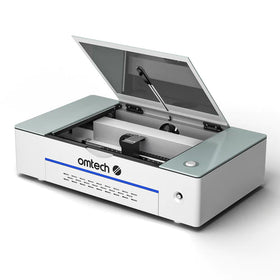
2. Best Mid-Range Desktop (CA$2,500-$4,000) OMTech 20W Galvo Fibre Laser Marking Machine with Autofocus
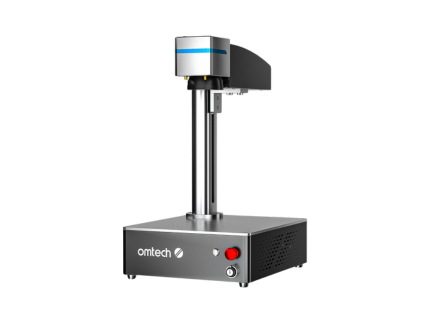
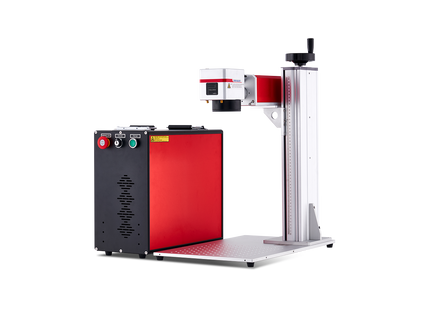
The OMTech Galvo 20W Compact and Integrated Fiber Laser Engraver is an affordable entry model 20W Galvo Fibre Laser Marking Machine from OMTech that engraves at a speed of up to 10,000mm/s, reaches an accuracy of ±0.04 mm, and is perfectly versatile for engraving words, logos, pictures, barcodes, and more on metal (including personalized gold and silver jewelry!) and other materials with quick turnaround and perfect accuracy.
3. Best Portable: xTool F2 5W IR and 15W Diode Portable Dual Laser Engraver
A portable, enclosed alternative designed specifically for detailed metal-marking tasks. The 15W diode easily processes colored anodized sheets, while the compact 5W infrared laser ensures you can still get perfect high-contrast marks on clear, uncolored anodized blanks. Available at Best Buy.
What to Look For When Buying a Laser Engraver For Anodized Aluminum
- Wavelength flexibility: Standard blue diode lasers (455nm) and CO2 lasers (10,600nm) are both incredibly efficient at stripping anodized dyes. If you plan to engrave other organic materials like wood or leather in the future, standard diode/CO2 lasers are the best choice for that flexibility.
- The "clear anodized" exception: Be aware that clear (silver) anodized aluminum has no pigment. Standard diode and CO2 lasers can't create contrast on clear anodizing, since there's no dark dye to bleach away; for clear coatings, you still need a 1064nm infrared or fiber source.
- Speed over raw power: You don't need massive 40W+ laser power just to remove dye; a 5W to 10W laser is plenty. Focus instead on movement speed (gantry or galvo style) and software compatibility (like LightBurn) to process your graphics quickly.

Choosing Laser Engravers for Raw/Bare Aluminum
To engrave raw or bare aluminum, you must use a 1064nm wavelength laser (commonly known as a fiber or infrared laser). Raw aluminum acts like a mirror to standard blue diodes and CO2 lasers, whose wavelengths it reflects away dangerously instead of absorbing, so nothing gets carved, and the reflected beam becomes a hazard.
Raw aluminum also dissipates heat exceptionally fast, meaning you need targeted, concentrated energy density to make a permanent mark.
Key Specs to Look For
- Wattage: For real material removal and deep engraving on raw aluminum, a 30W to 60W fiber laser is ideal. 20W fiber lasers work for surface marking, but higher wattage gives you cleaner depth and faster speeds.
- Lens size: Field lenses (like 110x110mm vs. 200x200mm) dictate your work area. Smaller lenses concentrate more energy per square inch, making deep engraving more efficient.
- Budget realism: Many "cheap" diode laser engravers ($200-$500) won't carve into raw aluminum at all. Good-quality entry-level fiber lasers usually start around $1,500 to $2,500.
Best Highly Rated Laser Engravers for Raw Aluminum
- ComMarker B4 (20W or 30W Fiber): A budget-friendly benchmark tool widely highlighted as the cheapest entry point for legitimate metal engraving. Equipped with a solid Raycus source that easily handles serialization numbers, tool tags, and surface text on 6061 plates.
- OMTech MOPA 30W Compact and Integrated Fiber Laser Engraver. The mid-range industrial sweet spot, highly praised on forums for customer service and sturdy configurations. It engraves at a max speed of 1000mm/s and reaches 0.01mm accuracy. With a large 6.9″×6.9″ work area, you can engrave metal surfaces, including aluminum, stainless steel tags, gold and silver jewelry, and more
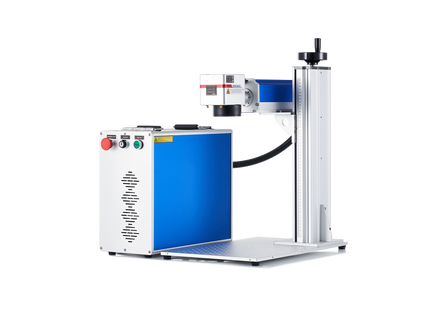
- OMTech 60W MOPA Split Fiber Laser: A high-volume heavy hitter, recommended for workshops needing to carve deep dimensional designs or demanding dark text on unpolished aluminum. Features a premium JPT M7 MOPA source that offers complete control over pulse width variations to prevent melted edge burrs.
Additional Buying Considerations
- MOPA vs. Q-switched: Standard Q-switched fiber lasers will engrave raw aluminum, but they leave a lighter gray or silver frost finish. If you want a dark black permanent mark on bare aluminum, you'll want a MOPA fiber laser, which lets you fine-tune the pulse duration to induce an oxidative blackening effect instead.
- Galvo system: True metal lasers use a high-speed mirror galvanometer system rather than a slow, moving gantry crane. Look for machines with galvo heads to complete highly detailed graphics in seconds.
- Software compatibility: Make sure the machine natively supports LightBurn. Proprietary, locked-down hobby apps tend to lack the fine frequency controls needed to achieve clean depth in raw metal.
Common Tips and Workarounds for Laser Engraving Aluminum
- Anodized aluminum: Bleaching or burning off the colored anodized layer to expose the raw silver metal underneath gives the cleanest contrast.
- Marking sprays: Products like Cermark or generic laser marking sprays bond to the raw aluminum surface under heat, though this creates a surface etch rather than deep material removal.
- Pre-painted/coated metal: Spray painting bare aluminum black, engraving the paint off, and cleaning the metal is a popular, cheap alternative to a dedicated fiber laser.
Top 5 Frequently Asked Questions About Laser Engraving Aluminum
1. Can you laser engrave aluminum without removing the anodized coating?
Yes, but the result depends on the type of aluminum and coating. With anodized aluminum, the laser typically removes or lightens the colored anodized layer rather than cutting into the underlying metal. If you want to create a permanent mark directly in bare aluminum, a fiber laser is generally required.
2. Can you laser engrave aluminum cans?
Yes, aluminum cans can be laser marked, but the results depend on the can's coating, thickness, and surface finish. A fiber laser can mark bare aluminum, while a diode or CO2 laser may work if the can has a suitable paint or anodized coating. Because cans are thin and curved, securing and focusing the material correctly is especially important.
3. Can you laser engrave aluminum business cards?
Yes. Aluminum business cards are commonly laser engraved, particularly when they have an anodized or painted surface. A diode laser can remove a colored coating to create a contrasting design, while a fiber laser is a better choice when you want to mark or engrave the underlying aluminum itself.
4. Can you laser engrave aluminum with LightBurn?
Yes, LightBurn can be used for many aluminum engraving applications, provided that the laser and controller are compatible with the software. It can be used to prepare text, logos, images, and other vector or raster designs before sending them to the laser. Always verify software compatibility before purchasing a machine.
5. How do you get a black mark on aluminum with a laser?
A black mark on aluminum can be produced using different techniques depending on the material. MOPA fiber lasers provide greater control over pulse duration and can produce darker marks on bare aluminum than conventional Q-switched fiber lasers. Another option is to engrave or mark a suitable coating using a lower-power laser.
Final Thoughts on Laser Engraving Aluminum
The single biggest decision in choosing a laser engraver for aluminum is whether you're working with raw metal or anodized stock; the two call for completely different machines and budgets. If you're only stripping colored anodizing, a diode or CO2 laser in the hundreds-of-dollars range will do the job well
If you need to mark or engrave bare aluminum, you're looking at a 1064nm fiber laser starting around $1,500-$2,500, with wattage and MOPA vs. Q-switched capability determining how deep and how dark your marks can get. Get that fundamental choice right first, and the rest of the buying decision- wattage, lens size, galvo speed becomes a lot easier to narrow down.
You may also be interested in whether fiber laser engravers are considered metal laser cutters and why these appellations matter a lot in metal laser engraving.